
Coronary artery disease is the most common heart
disease and the most common cause of death worldwide. According to WHO, 3-7 million
people die from coronary artery disease every year. An estimated data that CAD
is responsible for about 10% of disability-adjusted life years in low-income countries and 18% in high-income countries. The most common disease associated
with CAD is angina pectoris.
Angina Pectoris
Angina pectoris is a pain syndrome due to lack of oxygen
supply or increased demand of oxygen in a portion of the myocardium. Angina pectoris may cause sudden, severe chest pain that may radiate to the neck, jaw,
back, and arms. Also persist with nausea, vomiting, indigestion, and diaphoresis.
Types of angina
1) Stable / Classic / Typical Angina
2) Unstable Angina
3) Prinzmetal / Variant / Rest Angina
Stable Angina
Stable angina is the most common form of angina, and it
is usually characterized by a short, squeezing or burning feeling in the chest.
Some “atypical” condition with extreme fatigue, sweating, and nausea. The
typical condition is more common in women, diabetic patients, and old age.
Basically, stable angina occurs due to obstruction of an artery produced by atherosclerosis so that coronary perfusion is reduced.
Unstable Angina
Unstable angina is a form of acute coronary syndrome
and requires hospitalization to prevent progression of myocardial infarction (MI) and death. The severity is most due to rupture of atheromatous plaque, attracting platelet deposition and progressive occlusion of the coronary artery.
Prinzmetal / Variant / Rest / Vasospastic Angina
Prinzmetal angina is an unpredictable pattern of
angina that occurs at rest or sleep and is due to coronary spasm. In this case
decrease blood flow to the heart muscle from the spasm of the coronary artery.

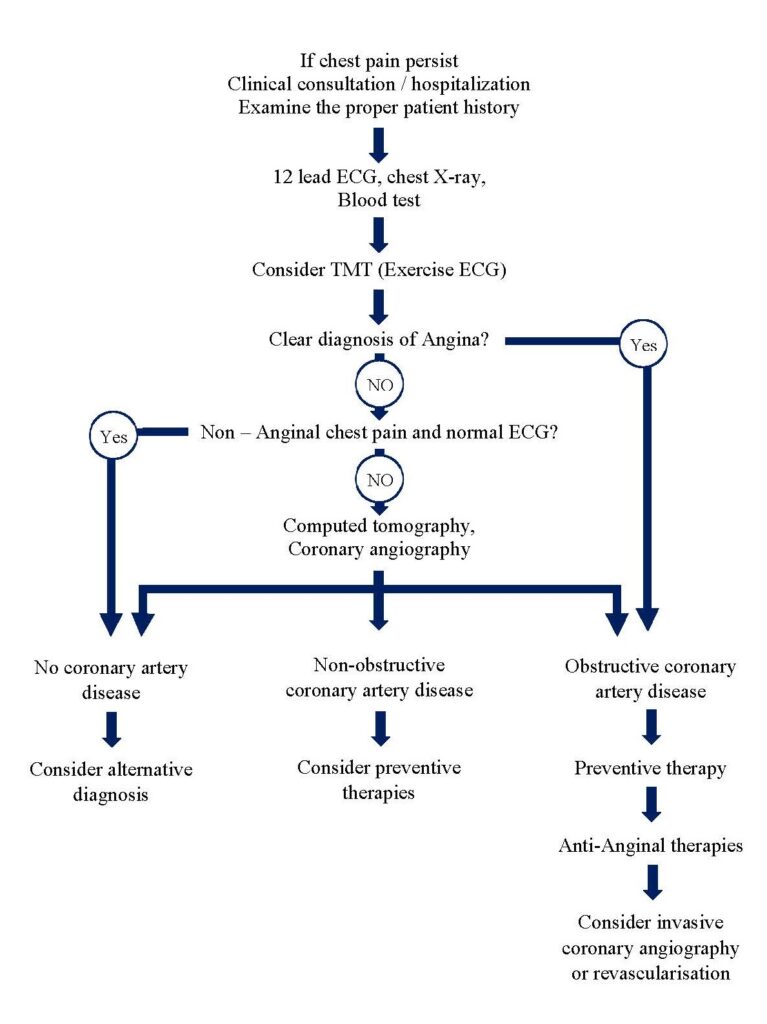
Clinical diagnosis
·
Stable angina is
characterised by central chest pain, discomfort or breathlessness.
·
Stress testing
·
Exercise ECG (TMT)
planar or down sloping ST segment depression of 1mm or more in indicative of
ischaemia. Up sloping ST depression in less specific (False positive results).
·
Echocardiogram
(Echo)
·
Angiography
Management
·
Life style
management.
·
Anxiety and
misconception should be prohibited.
·
Proper education.
·
Cessation of
smoking.
·
Identification of
risk factor.
·
Proper medication
therapy.
·
Patients with
angina secondary to CAD should receive antiplatelet therapy.
·
Low dose of
Aspirin (75mg).
·
Clopidodrel (75mg
/ day) in an equally effective alternative if Aspirin cause dyspepsia or other
side effects.
·
Consider station,
even cholesterol level is normal.
Statin (HMG-COA reductase)
It is a class of drugs that lowers the level of
cholesterol, in the body by decreasing the production of cholesterol in liver.
Statin blocks the enzyme hydroxyl methyalglutaryl coenzyme A reductase (HMG-COA
reductase). Some example of statin are as follows:
·
Atorvastatin
(Lipitor)
·
Fluvastatin
(Lescol, Lescol XL)
·
Levastatin
(Mevacor, Altoprev)
·
Pravastatin
(Pravachol)
·
Rosuvastatin
(Crestor)
·
Simvastatin
(Zocor)
·
Pistavastatin
(Livala)
Anti-Anginal drug therapies
1.
Nitrates
a)
Short
acting: Glyceryl Nitrate (GTN,
Nitrogycerin)
b)
Long
acting: Isosorbide dinitrate
(short acting by sublingual route), Isosorbide mononitrate, Erythrityl tetra
nitrate, Pentaerythritol trinitrate.
2.
β –
Blockers: Propranolol, Metoprolol,
Atenolol and others.
3.
Calcium channel
blockers:
a)
Phenyl
alkylamine: Verapamil
b)
Benzothiazepine:
Diltiazem
c)
Dihydropyridine:
Nefidipine, Felodipine, Amlodipine,
Nitrendipine, Nimodipine, Lacidipine, Lercaniipine, Benidipine.
4.
Potassium
channel opener: Nicorandil.
5.
Others: Dipyridamole, Trimetazidine, Ranolazine, Ivabradine,
Oxyphedrine.
Nitrates
GTN has the short duration of action therapies, when
it administered in sublingual route. GTN administered metered-dose aerosol
(400µg/day) or as a tablet (300 or500 µg) is usually relieve an attack in 2-3
minutes.
·
GTN transcutaneous
(5-10 daily)
·
Slow release
buccal tablet (1-5 four times daily)
·
Isosorbide
dinitrate (10-20mg 3 times daily)
·
Isosorbide
mononitrate (20-60mg once / twice daily)
Continuous therapy of Nitrates can cause
pharmacological tolerance, but this can be avoided by 6-8 hours nitrate free
period.
Duration of action of Nitrates
|
Preparation |
Peak action |
Duration of action |
|
Sublingual GTN (0.5mg) |
4-8mins |
10-30mins |
|
Buccal GTN |
4-10mins |
30-300mins |
|
Transdermal GTN |
1-3hrs |
Up
to 24hrs |
|
Oral Isosorbide dinitrate (5-10mg
Sublingual, 10-20mg Oral) |
45-120mins |
20-40mins 2-6hrs |
|
Oral Isosorbide Mononitrate (20-40
oral) |
45-120mins |
6-10hrs |
|
Erythrityl tetranitrate (5-15mg tablet) |
|
3-6hrs |
|
Pentaerythritol tetranitrate (0mg
tablet, 80mg SR tablet) |
|
3-5hrs 8-12hrs |
Mechanism of action of nitrates
·
Organic nitrates
are metabolized or denitrated enzymatically in smooth muscle cells to release
the reactive free radical nitric oxide (NO).
·
This increases cytosolic guanylyl cyclase, thus increasing cGMP (cyclic guanosine
monophosphate), which causes dephosphorylation of myosin light chain kinase
(MLCK) through a cGMP-dependent protein kinase.
·
Reduced availability of phosphorylated (active) MLCK interferes with actin to cause
contraction; consequently, relaxation occurs.
·
Raised
intracellular cGMP may also reduce Ca2+ entry, contributing to relaxation.

Pharmacokinetics
Organic nitrates are lipid soluble. Well absorbed from the buccal mucosa, intestine and skin. Isosorbide dinitrate undergoes extensive and variable first-pass metabolism in the liver. The partial metabolites (denitrated by glutathione reductase and mitochondrial aldehyde dehydrogenase) are less active but longer-acting.
Adverse effect
Headache;
tolerance develops on continued use. Flushing, weakness, sweating, palpitation,
dizziness, and fainting. Methamoglobinemia, rashes are rare (mostly with
pentaerythritol tetranitrate).
Tolerance
Generally, long-acting or sustain acting preparation produced tolerance. The mechanism of
tolerance is not understood, but it happens due to reduced ability to generate
NO. To prevent tolerance, provide the patient with a free interval every day.
Interaction
Sildenafil causes severe hypotension, MI, and death.
|
Drug
class |
Adverse
effect |
Drug
interaction |
Instruction |
|
β-blocker. ·
Atenolol ·
Metoprolol ·
Propranolol |
·
Bradycardia worsening ·
peripheral vascular disease, ·
fatigue ·
sleep disturbance ·
depression ·
blunt hypoglycaemia awareness ·
asthma |
β2 agonists (blunted effect);
nondihydropyridine calcium-channel blockers
(additive effects) |
·
β1-selective agents
preferred ·
(Atenolol, metoprolol). |
|
Dihydropyridine
calcium channel Blockers. ·
amlodipine ·
felodipine ·
nifedipine |
·
Peripheral edema ·
headache ·
Fushing ·
rebound tachycardia (immediate
release formulations) ·
hypotension |
CYP
3A4 substrates (will increase drug concentrations) |
·
Avoid short-acting agents as they can
worsen angina. |
|
Non
dihydropyridine calcium channel Blockers. ·
diltiazem ·
verapamil |
·
Bradycardia ·
Constipation ·
Heart failure ·
Gingival hyperplasia (verapamil) ·
Edema (diltiazem) |
CYP
3A4 substrates (will increase drug
concentrations); increase digoxin
levels; β blockers and other
drugs affecting AV node conduction
(additive effects) |
·
Avoid in patients with heart failure |
|
Organic
nitrates ·
isosorbide dinitrate ·
isosorbide mononitrate ·
nitroglycerin |
·
Headache ·
Hypotension ·
Flushing ·
tachycardia |
Contraindicated
with PDE5 inhibitors
(sildenafil and others) |
·
Ensure nitrate-free interval to prevent
tolerance |
|
Sodium-channel
inhibitor ·
ranolazine |
·
Constipation, headache, edema, dizziness,
QT interval prolongation |
Avoid
use with CYP 3A4 inducers (phenytoin,
carbamazepine, St.
John’s wort) and strong inhibitors
(clarithromycin, azole antifungals)
and agents that prolong
QT interval (citalopram, quetiapine,
others) |
·
No effect on hemodynamic parameters |

With a foundation in pharmacology, I am engaged in both teaching and research. My work has been published in reputed national and international journals, and I actively participate in scientific conferences to share findings and stay connected with emerging advancements. Thank you for visiting. Your interest is truly appreciated.