
Pharmacy | · Pharmacy is a health profession and scientific discipline that deals with the discovery, preparation, dispensing, and appropriate use of medicines to ensure safe, effective, and rational therapy. · It acts as a vital link between medical science and patient care, focusing not only on the formulation and quality of drugs but also on providing accurate drug information, counselling patients, and promoting health and disease prevention. |
Drug | · Drugs are chemical or biological substances that are used for the diagnosis, prevention, treatment, or cure of diseases in humans or animals. · They act by modifying or influencing physiological or pathological processes in the body and are administered in appropriate doses to achieve therapeutic effects while minimizing adverse effects. |
Pharmacology | · Pharmacology is the branch of medical and pharmaceutical science that deals with the study of drugs, their sources, and properties, mechanisms of action, therapeutic uses, and adverse effects on living systems. It explains how drugs interact with the body and how the body affects drugs. |
Toxicology | · Toxicology is the branch of medical science concerned with the study of poisons, their sources, properties, toxic effects, detection, treatment, and prevention of poisoning in living organisms. |
Therapeutics | · Branch of medicine concerned with the cure of disease or relief of symptoms, including treatment using drugs. |
Chemotherapy | · Chemotherapy is the branch of pharmacology concerned with the treatment of diseases by the use of chemical agents, especially drugs that destroy or inhibit the growth of pathogenic microorganisms or malignant cells (Cancer cells), with minimal harm to the host. |
Pharmacopoeia | · A pharmacopoeia is an official, legally recognized book that provides standards for the identity, purity, strength, and quality of drugs and pharmaceutical substances, along with methods of preparation, testing, and storage to ensure the safety and effectiveness of medicines. |
Drug attachment
Agonist | · An agent that activates a receptor to produce an effect similar to that of the physiological signal molecule. | |
Partial agonist | · An agent that activates a receptor to produce submaximal intrinsic activity · Example: Dichloroisoproterenol (on β-adrenergic receptor), pentazocine (on μ opioid receptor). | |
Inverse agonist | · An agent that activates a receptor to produce an effect in the opposite direction to that of the agonist. | |
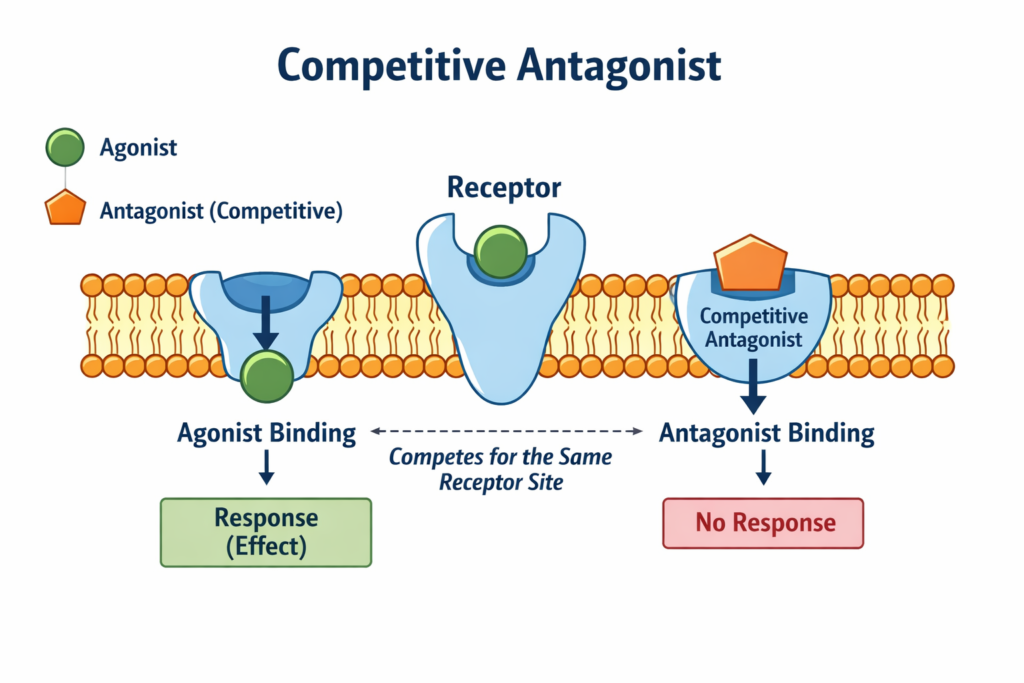
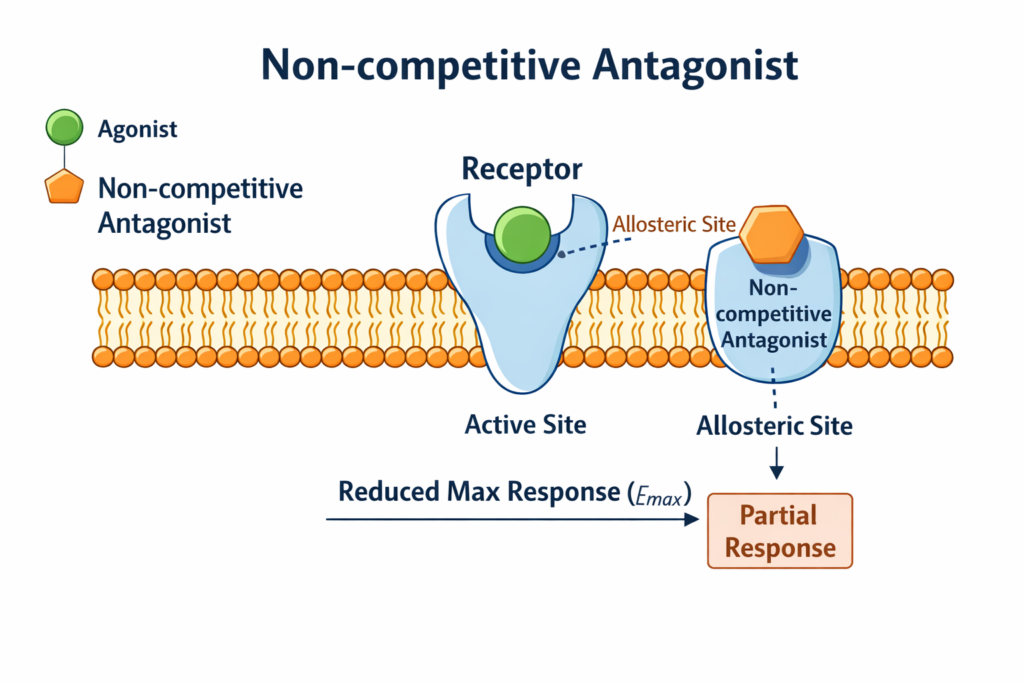
Antagonist · An agent that prevents the action of an agonist on a receptor or the subsequent response, but does not have any effect of its own. · Antagonist is of two types: competitive and non-competitive antagonist | ||
Competitive antagonist · The agonist and antagonist bind to the same site of the receptor; they are said to be “Competitive”. · The efficacy and repulsion depend on the concentration of the agonist and antagonist. · Drug response curve shifted rightward. · Example: Acetylcholine = Atropine, Morphine = Naloxone.
| Non-competitive antagonist · It binds to another side of the receptor. · The response depends on the concentration of the antagonist. · Drug response curve is flattening. · Example: Diazepam = Bicuculline
| |
Selectivity | · Degree of complementary correlation between drug and receptor · Example: Adrenaline Selectivity for α, ß Receptor. | |
Affinity | · The ability of a drug to bind to the receptor. | |
Intrinsic activity (IA) or Efficacy
| · The ability of a drug to produce a pharmacological response after binding to the drug receptor complex. | |
Ligand | · Any molecule that attaches selectively to particular receptors or sites. | |

With a foundation in pharmacology, I am engaged in both teaching and research. My work has been published in reputed national and international journals, and I actively participate in scientific conferences to share findings and stay connected with emerging advancements. Thank you for visiting. Your interest is truly appreciated.