
Cell Division
Cell division is the process by which a cell reproduces itself. Most cells of the human body undergo cell division. There are two types of cell division: mitosis and meiosis. In this process, there is formation of two identical daughter cells.
Interphase
· During interphase, the cell replicates its DNA as well as produces an additional set of organelles or cytosolic components.
· It is a high metabolic activity stage.
· Interphase consists of three phases:
1. G1 phase
2. S phase
3. G2 phase

G1 phase
· The G1 phase is the interval between the mitotic phase and the S phase.
· This stage is metabolically active, and it replicates most of its organelles and cytosolic components but does not replicate its DNA.
· It takes 8-10 hours to complete the G1 phase. Some muscle cells and nerve cells do not reproduce themselves; such type of cells is in G0 phase. If the cell dies, its function is also lost.
S phase
· The interval between G1 and G2 and it is lasts about 8 hours. In this stage, DNA replication occurs, and two identical cells are formed.
G2 phase
· The G2 phase is the interval between the S phase and the mitotic phase. It lasts 4 to 6 hours.
· In this stage, complete replication of the centrosome occurs, and protein and enzyme synthesis continues for cell division.
· During DNA replication in S phase, its helical structure partially uncoils, and the two strands separate at the points where hydrogen bonds connect base pairs.
· Each exposed base of the old DNA strand then pairs with the complementary base of a newly synthesized nucleotide.
· A new DNA strand is taking shape due to the formation of chemical bonds between neighboring nucleotides.
· The uncoiling and complementary base pairing continues until each of the two original DNA strands is joined with a newly formed complementary DNA strand.
· The original DNA molecule has become two identical DNA molecules.
Mitosis
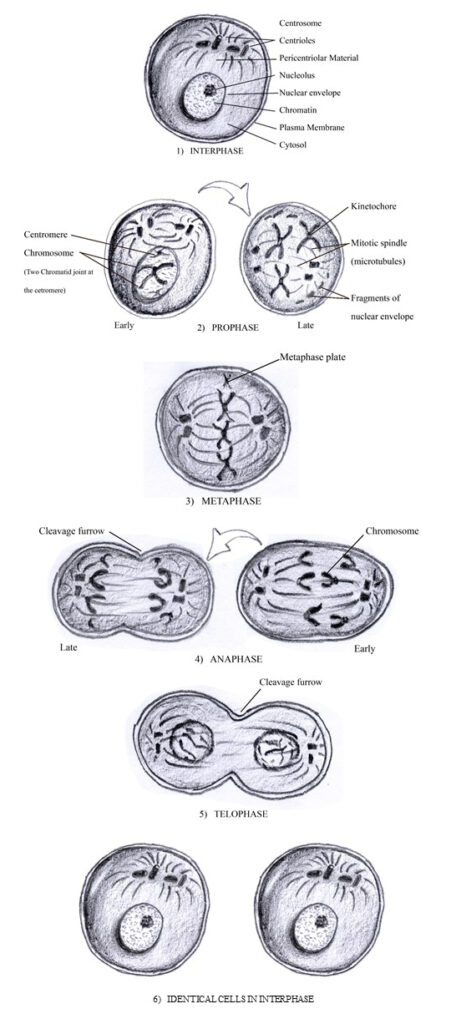
· In mitosis, one cell with the diploid number of chromosomes (46) divides into two identical cells, each with the diploid number of chromosomes.
· This production of cells is necessary for growth and repair of tissues.
· The process of DNA replication enables each chromosome (in the form of chromatin) to make a copy of itself.
· The time taken for the conversion of the duplicate is called interphase or the resting phase.
· The mitotic phase results in the formation of two identical cells, which consists of a nuclear division (mitosis) and cytoplasmic division (cytokinesis). The mitotic phase is divided into four phases:
1. Prophase
2. Metaphase
3. Anaphase
4. Telophase
Prophase
· In the early part of this phase, the chromatin becomes tightly coiled or condenses into chromosomes that are easier to see under a microscope. This process helps to prevent the entanglement of the long DNA strands.
· Each prophase chromosome consists of a pair of identical strands called chromatids. The two chromatids are joined to each other at the centromere.
· At the outside of each centromere is a protein complex known as the kinetochore.
· Later in prophase, tubulins in the pericentriolar material of the centrosomes start to form the mitotic spindle (assembly of microtubules that attach to the kinetochore).
·
Then the mitotic spindle moves to the opposite
pole and separates the chromatids. The nucleolus disappears, and the nuclear
envelope breaks down.
Metaphase
·
The chromatids align at the center of
the spindle, attached by their centromeres.
Anaphase
·
The centromeres separate, and one of
each pair of sister chromatids (termed a chromosome) migrates to each end of
the spindle as the microtubules that form the mitotic spindle contract.
·
It appears V-shaped.
Telophase
·
It is the last phase of mitosis; the
mitotic spindle disappears, the chromosomes uncoil, and the nuclear envelope
reforms.
Cytokinesis
·
Cytoplasmic division: the contractile
ring forms a cleavage furrow around the center of the cell, dividing cytoplasm
into separate and equal portions.

With a foundation in pharmacology, I am engaged in both teaching and research. My work has been published in reputed national and international journals, and I actively participate in scientific conferences to share findings and stay connected with emerging advancements. Thank you for visiting. Your interest is truly appreciated.